Lesson 5 of 5 · How Learning WorksRead
Batch, Epoch, Step, Token Budget: How Training Progress Is Measured
How a training run is counted in steps and tokens, why a language model like GPT-3 sees some sources not even halfway and others several times, how a held-out text tells real learning apart, and how much text goes with how many faders.
The Llama 3 family are the language models from the company Meta. For its largest model, Llama 3.1 405B, the research report gives two numbers that both sound like the length of training. The first number you know from the previous lesson: the learning-rate schedule, up briefly first, then down for a long time, ran over 1.2 million steps for this model. What one step counts here is explained in the section “Problem, batch, step”. The second number is the amount of text, about 15.6 trillion tokens, that is, pieces of text.
Another team also trains for 1.2 million steps (a step here is one round in which every fader moves once) and puts 4 million tokens into each step. How much text has its model seen by the end, compared with the largest Llama model’s 15.6 trillion? Think for a moment before you read on.
Problem, batch, step
The answer lies in what a single step processes. Remember the cover card? It uncovers the beginning of a line, and the next token underneath is the solution. That way, every position in a training sequence becomes a practice problem, an example. For a whole stack of such sequences the model computes forward, and the loss averages the penalty points of all positions into one single number. This stack is called a batch.
From the loss come the notes from the lesson on backpropagation: each fader carries how strongly and in which direction the loss changes when you turn it. The optimizer then turns every fader once, each one so that the loss falls.

A workbook helps keep these units apart. You do not have each problem corrected right away, but a whole stack. Then comes the correction, and you adjust your way of working a little. In the picture, each problem is an example, the stack is the batch, your way of working is the faders, and each round of corrections is a step. Once through the whole workbook is called an epoch. The picture fails in three places. The model has no workbook in which individual problems are kept. It only has its faders, and spread across them is what it has kept from the problems, above all what many problems have in common. If the same problem comes up again later, an already changed model solves it. How strongly it adapts to a single problem also depends on how often that problem came up. And a language model does not simply work through its workbook page by page: how often each part comes up is decided in advance.
In technical language, such a round is called a step. A step runs one batch forward, works out the loss and the notes from it, and then turns the faders once. In the lesson on training, a step was still the distance a fader moves. As a unit of counting it means the whole round in which every fader moves once.
Now to the question from the start. The other team gets 1.2 million steps times 4 million tokens, that is 4.8 trillion tokens. That is just under a third of the text the largest Llama model saw. The team took just as many steps and still saw far less text. The largest Llama model started out the same way, but then doubled twice, up to 16 million. Step counts can only be compared if the batches are the same size. So the text a run has processed is counted in tokens.
So the steps count the rounds of corrections, the tokens count the text. How often does the same training text actually come up?
Once through the workbook, or not at all
Many imagine a language model reads its training data again and again until it knows it. That is how you learn: before an exam, you work through the workbook two or three times. With GPT-3, a predecessor of the models behind ChatGPT, it was different: most of the available text came up less than once. The Llama 3 report gives no epoch counts.
How often a source comes up is set by the mix, the last stage of preparing the training data from the lesson on practice problems. For each source, a share of the training sequences is set. The training text is distributed by these shares, not by the size of the sources.
The GPT-3 paper gives all the numbers. Training processed 300 billion tokens in total. 60 percent of them came from a filtered collection of web pages called Common Crawl. For Common Crawl, the paper gives 0.44 epochs: not even half of its texts came up. The rest was shared among selected web pages, two collections of books and Wikipedia.
Wikipedia held only 3 billion tokens and still got 3 percent of the mix. How often do you think it came up in training?
3 percent of 300 billion is 9 billion tokens, from a collection of 3 billion.
The epochs roughly follow from the tokens drawn, divided by the size. For Wikipedia, that makes three times.
The paper gives 3.4 times; the calculation comes to 3. That is enough to see the order of magnitude.
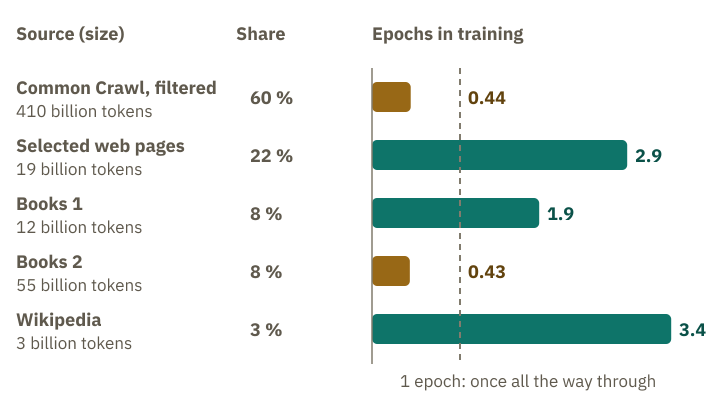
Why so uneven? According to the paper, training deliberately drew more often from sources the authors considered higher quality. In exchange, they accepted “a small amount of overfitting”: the model then adapts to individual texts instead of to patterns many texts share. How much repetition hurts is shown by a 2023 study on language models with up to 9 billion parameters: up to about four epochs, the loss on new text barely changed. With more repetition, additional compute brought less and less, eventually nothing. Whether this also holds for GPT-3 is something the study does not measure.
Which sources come up more often shapes the later model. According to Meta, setting the shares carefully is critical for a good language model. For the largest Llama 3 model, roughly a sixth of the training tokens come from code. If a chatbot helps you code, its pre-training very likely contained a lot of code.
Because a mix repeats each source a different number of times, one epoch count says little. Instead, you count all the tokens training processes, repetitions included. That is the token budget: 300 billion for GPT-3. People set the token budget before training, so it is a hyperparameter.
How many steps does a training run take? For the largest GPT-3 model, the paper gives a batch of 3.2 million tokens alongside the 300 billion tokens. Take a moment to think before you read on.
Live demo · try it yourself
How many steps does the training take?
Invented simulationThe sliders start at GPT-3’s values: 300 billion tokens of training text, 3.2 million tokens per batch. First guess how many steps that makes. Once you have worked it out, you can change the token budget and the batch and see how often each source of the mix comes up.
Steps
?
How often each source comes up
Vertical line: once all the way through, one epoch. Amber: not yet all the way through once. The bars go up to four epochs.
Try it: what happens to the steps if you make the batch four times as large? And from what token budget does Common Crawl get all the way through once?
Solution
With 3.2 million tokens per batch, GPT-3 takes 93,750 steps for 300 billion tokens, just under 94,000. With a batch four times as large, 12.8 million, it is 23,438, a quarter of that, for exactly the same text. The epochs per source do not change: they depend on the token budget alone. The filtered web-page collection would only get all the way through once from about 680 billion tokens, by which point Wikipedia would be at seven to eight epochs.
GPT-3’s token budget, batch and mix from the 2020 research paper (Brown et al.); the other slider positions are made up. The epochs per source come from the paper’s table for 300 billion tokens and grow here in proportion to the token budget. The demo leaves out that GPT-3’s batch was smaller at the start.
Each step uses up 3.2 million of the 300 billion tokens.
How many steps that gives is a division: 300 billion is 300,000 million. Divided by 3.2 million, that makes just under 94,000 steps. The batch started smaller, so there were a few more. It remains open how you can tell overfitting during training at all.
Do Llama 3.1 405B’s 1.2 million steps fit the division?
With the largest batch of 16 million tokens, 15.6 trillion tokens would give 975,000 steps. But in the first trillions of tokens, the batches were only 4 and 8 million. So the run needs more steps; 1.2 million is the same order of magnitude.
The practice test: learning or memorizing

If you work through a workbook three times, by the end you know many solutions by heart. Whether you have mastered the material only shows in a practice test with problems that were not in the workbook. It is the same with training. The loss that training computes after each batch measures how well the model predicts exactly the texts it is learning from right now. It is called the training loss. It falls even when the model only adapts to quirks of those texts. In the workbook, that would be someone who knows the solutions but not how to get there.
That is why part of the text is held back before training: the held-out text. It never goes into a batch, and no fader is turned according to it. At regular intervals the model computes it forward, and the loss on it is called the validation loss. The developers of GPT-3 removed duplicate texts partly so that no copy of the held-out text would hide in the training text. Otherwise the practice test would be one with familiar problems.
Both values are recorded. If both curves fall and stay close together, the model is learning patterns that also hold in unseen text. If the training loss keeps falling while the validation loss rises again, that is the overfitting the GPT-3 paper accepted.
A small, real training run shows what that looks like. A tiny model with about 14,000 parameters predicts the next character, each time from the eight characters before it. It learns from Franz Kafka’s story “The Metamorphosis”, whose last tenth is the held-out text. Two runs start from the same random fader settings, so only the amount of text makes a difference. The small one gets the first 4,000 characters, the large one about 109,000 characters, almost all of the rest of the story. Both see their text 50 times.
What do you think happens to the validation loss of the small run when it sees the same 4,000 characters for the twentieth, thirtieth, fiftieth time?
Note your guess before you read on.
Live demo · try it yourself
When does the validation loss start to rise?
Real output, computed in advanceA tiny model learns from Kafka’s “The Metamorphosis”, in the German original. Move the slider through the 50 epochs and watch the two loss curves develop. Think first: where does the validation loss go with the small text?
Training loss:
Validation loss:
Solution
With the small text, the validation loss is lowest after 9 epochs, at 2.44. After that it rises to 3.62 by the 50th epoch, while the training loss keeps falling to 0.30: the model adapts to the 4,000 characters it knows. With the large text, the validation loss falls to about 1.67 and stays almost flat from around the 16th epoch, just above the training loss. More text pushes overfitting back.
A real training run, computed in advance on a computer: a character model with 13,683 parameters that predicts the next character from the 8 before it, 128 examples per batch. The held-out text is the last tenth of the story (12,103 characters). Both runs start from the same random fader settings. A language model like Llama 3.1 8B has more than half a million times as many parameters; the run only shows how to read such curves.
Both curves start at about 4.3, because the mini model has only 67 different characters to choose from.
A language model with over 150,000 tokens in its vocabulary, by contrast, starts at about 11.9. The more tokens there are to choose from, the higher the starting value, because at the start each one gets only a tiny share.
In the small run, the validation loss falls for nine epochs and then rises steadily again. The training loss keeps falling throughout: the model predicts the 4,000 familiar characters ever more confidently and unseen text ever worse.
In the large run, the validation loss falls until about epoch 15 and then stays at about 1.67, while the training loss keeps falling. The gap between the two grows slowly, from about 0.2 to about 0.3. But the validation loss does not rise again. From the same start, it reaches a clearly lower loss on the held-out text.
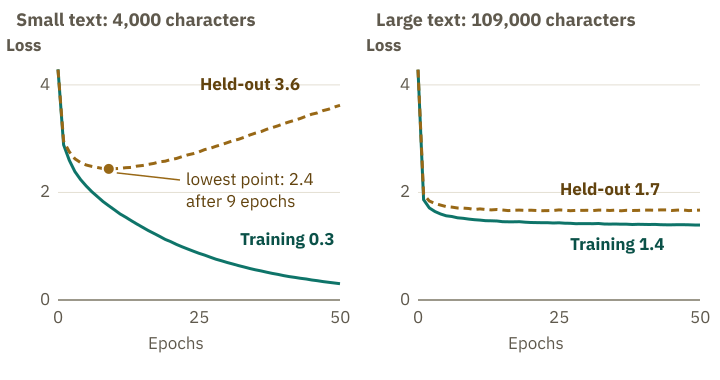
The mini model is not a language model like the one behind your chatbot: even Llama 3.1 8B has more than half a million times as many parameters. The mini model only knows characters and has only read one story. It shows how to read the two curves. It does not show how early a large model would tip over. Here the picture has a limit: a practice test checks whether a person knows the material. The validation loss only measures how well the model predicts the next character on held-out texts.
So more text helps against memorizing.
How much text for how many faders
A team has compute for one training run. Should it train a large model briefly or a smaller one for longer? The compute grows with model size times amount of text. A model twice as large needs twice the computation per token, so for the same compute it gets half the text.
DeepMind, Google’s AI company, looked into this. It trained many language models of various sizes on various amounts of text and compared which reached the lowest loss for the same compute. It found that model size and token budget should grow equally, so twice the parameters with twice the text. On this finding, many large models of the time were undertrained. As proof, DeepMind trained Chinchilla with 70 billion parameters and 1.4 trillion tokens. It cost as much compute as a model four times as large, but got four times the text and did better.
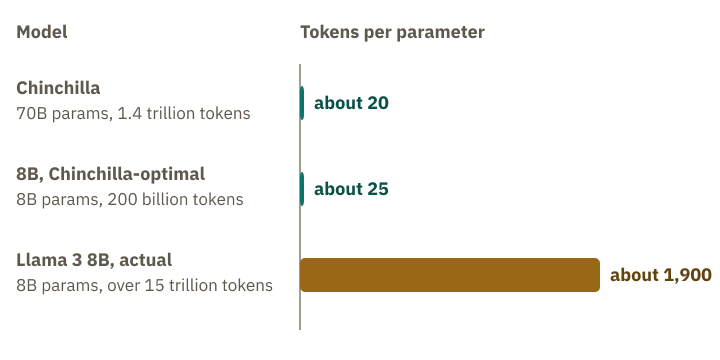
1.4 trillion is 1,400 billion. Divided by 70 billion, that gives 20.
This became a common rule of thumb: about 20 tokens per parameter.
Llama 3 8B has eight billion parameters. Meta writes that by the Chinchilla calculation, about 200 billion tokens would be optimal for this model.
Divided by eight billion, that is about 25 tokens per parameter. The 20 is a rule of thumb from the Chinchilla example. Each model’s own sum gives somewhat different values; Meta’s model with eight billion parameters comes out at about 25.
It was trained on over fifteen trillion tokens, which is 15,000 billion.
Divided by eight billion, that gives about 1,900 tokens per parameter, instead of 20.
Is that a waste?
Meta reports that the model was still improving after 15 trillion tokens. A larger model would have reached the same performance with less training compute. According to Meta, smaller models are still generally preferable because they are more efficient in use. A finished model answers millions of requests, and every token it outputs is computed with all its faders. A smaller model trained for longer answers more cheaply and fits on smaller chips, such as those in phones.
For training alone, the cheapest ratio is about 20 tokens per parameter. If you also count running it, you train a smaller model for longer.
One level deeper: How scaling laws make a training run predictable
This planning rests on an observation from 2020. Researchers at OpenAI, the company behind ChatGPT, trained many language models of varying size, amount of text and compute (Kaplan and others). The loss on held-out text fell regularly. It follows a power law in model size, amount of text and compute, sometimes across more than seven orders of magnitude: the largest value studied was over ten million times the smallest.
A power law here means: every tenfold increase, say in the number of parameters, lowers the loss by the same proportion, as long as neither text nor compute runs short. Rules like this are called scaling laws.
From rules like these you can work out how best to split a fixed compute budget. According to Kaplan, mainly the model should grow as the budget grows. In 2022, the Chinchilla study redid this with more runs and more text: model and text should grow equally. Both laws only describe the loss, not individual abilities such as arithmetic or translation.
At the end of millions of such steps stands a model that continues text well. It is a base model like Llama 3.1 8B: the model before post-training. It has not learned to respond to questions as a chatbot does. That takes post-training, which the next topic area, “From Model to Assistant”, covers.
Explain it more simply
- Explain more simplyCore idea and an everyday comparison
- With an exampleOne concrete example, step by step
- In more detailEvery step on its own, in plain words
Recall moment
What stayed with you?
Answer without scrolling back. This is not a grade; the point is to retrieve what you learned from memory once. As soon as you pick an answer, you see whether it is right.
Preparing questions …
Questions from the community
Something still unclear? Ask your question about this lesson on the community board. Other learners and the project answer there, and you can see what others have already asked.