Lesson 3 of 6 · FoundationsRead
Tokenizers: How Language Becomes Numbers
Shows how a tokenizer splits text into reusable pieces, numbers them through a fixed vocabulary, and turns them into the numerical input of a language model.
Before you read on, split this word into pieces in your head: “unbelievable.” One piece, three parts such as “un–believ–able,” or every letter on its own? All three could serve as input for a computer, but they lead to very different lists of numbers. This is exactly the decision a tokenizer makes.
In the previous lesson, the input of a language model was still a sequence of “text pieces”. Now you see what lies between your readable sentence and that input: the text is cut into pieces, and every piece gets a number. Only this sequence of whole numbers goes into the model.
A model never gets to see text
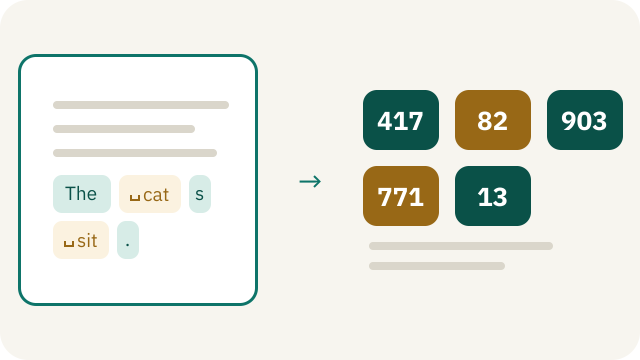
Your screen might show “The cats sit.” To you, that is words, spaces, and a period. The model needs something else: a fixed list of text pieces that does not keep growing. You know why from the previous lesson: a language model outputs its own score for every text piece it knows. That only works if it is settled which text pieces exist and how many. Open-ended text of any length must therefore first be translated into pieces from this fixed list.
The split decides how long the input is for the model: one visible word can become one, two, or many pieces. They are called tokens. How text is split is fixed by the tokenizer before the model calculates anything.
The tokenizer does not understand the sentence or pick pieces by feel. It works by fixed rules. So the same text gives the same token sequence with the same tokenizer; only during training do some methods add randomness on purpose. A different tokenizer may split it differently. So there is no one natural tokenization hidden inside language.
Why not simply number every word?
The most obvious idea: take a dictionary, give every word a number, done. “The” could be 417, “cats” 982, and “sit” 771. For a carefully limited collection of texts, that works. For open-ended language, it does not.
Which entries would the list need? “Friend,” “friendly,” “unfriendly,” “unfriendliness,” and every further word built the same way? Plus names, product labels, typos, forms such as “learn,” “learns,” and “learned,” and words coined tomorrow. A list can grow large, but it stays limited, while language keeps forming new character sequences.
Unknown words could share a single placeholder. But then two completely different new names would both shrink to the same “unknown” symbol. A chatbot would see nothing but “unknown” for every new name, say that of a band founded last week.
Why not take every letter on its own?
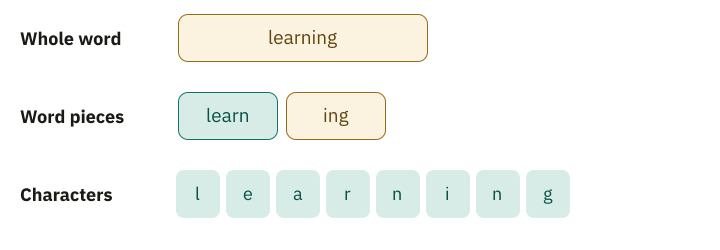
At the other end lies an equally simple solution: every letter and punctuation mark becomes a token. Then almost any word can be assembled, even a new one, and the list of pieces stays small. “Cats,” however, now takes four tokens instead of perhaps one or two.
Every token takes up its own place in the input, called a position. In a long document, this multiplies the positions the model has to process. With spaces and the period, “The cats sit.” already has 13 character positions. With single characters, a chatbot would also need a separate round of the text loop for every letter of its answer. A coarser split needs far fewer tokens.
Single characters also carry very little. The model would have to rebuild frequent sequences such as “ing”, “tion”, or “str” from many positions every time. Whole words are too coarse; single characters are flexible but needlessly fine-grained. A workable middle ground is needed.
The useful middle ground: reusable word pieces
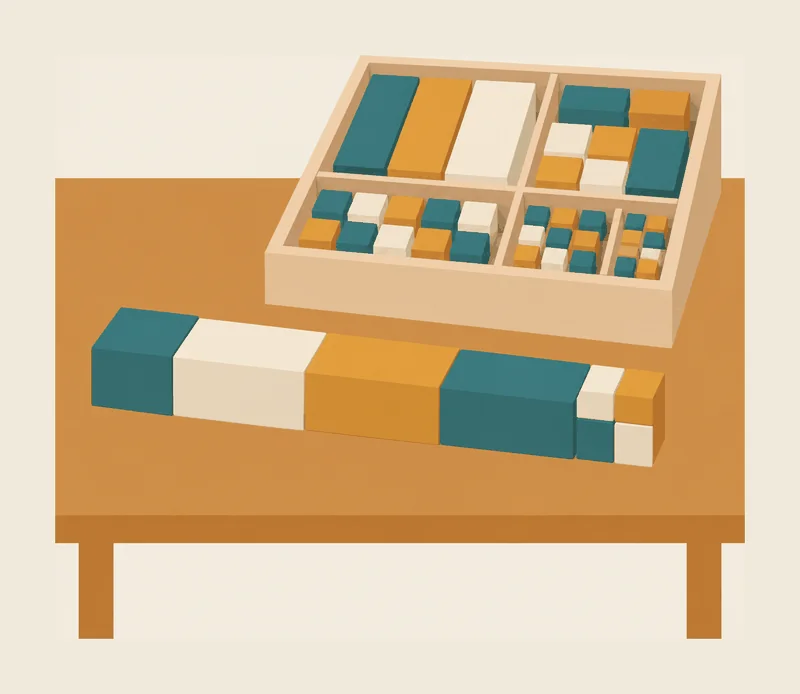
Many modern text tokenizers therefore use subword tokens: a token can be a frequent whole word, a recurring word part, or a single character. It works like a building set: frequent things come as large finished pieces, rare things you assemble from small parts. The tokenizers behind well-known chatbots such as ChatGPT work this way, too. “Learning,” for example, might split into “learn” and “ing.” Only a thought example; another tokenizer might know the word whole or choose “le”, “arn”, “ing”.
Which pieces exist depends on the text material and the procedure that built the vocabulary, the fixed list of all pieces a tokenizer knows. And “unbelievable” from the start? A subword tokenizer might keep it whole or take two or three frequent pieces, chosen by its learned vocabulary, not by syllable rules. Because almost any word can, if necessary, be assembled from single characters, such a tokenizer rarely needs an “unknown” placeholder.
This middle ground is not perfect. A frequent pattern is represented briefly; an unusual spelling can fall apart into many small pieces. So the token count is not the word count, and two sentences of similar length can need different numbers of tokens. Even capitalization, spaces, or an accent can change the split.
Where do the pieces come from? Unlike in a building set, nobody designed them. They are learned from large amounts of text: a procedure counts which characters often stand next to each other and merges them step by step into larger pieces. The details follow below under “One level deeper.”
Keeping token, tokenizer, and vocabulary apart
How does the tokenizer know which pieces exist, such as “ cat” or “s”? Three things are easy to confuse here. A token is a single unit, for example “ cat” (with a space in front, more on that shortly), “s”, or “.”. The vocabulary assigns an ID to every permitted unit. The tokenizer is the procedure, including rules and vocabulary, that splits text into these units and joins them back into text.
Picture the vocabulary as a card index: each card holds a text piece and an identifying number. The tokenizer finds a matching sequence of cards for your sentence and outputs their numbers. On the way back, it looks up the numbers and joins the pieces again. Both directions run with every chatbot message: there with your question, back with every piece of the answer.
The picture has a limit: the tokenizer does not search for cards that “fit the meaning.” Its splitting rules fix which sequence is chosen. And the card with “ cat” holds no definition of a cat, only a sequence of characters. What the model later connects with this card emerges only through its trained parameters.
An ID is a label, not a meaning
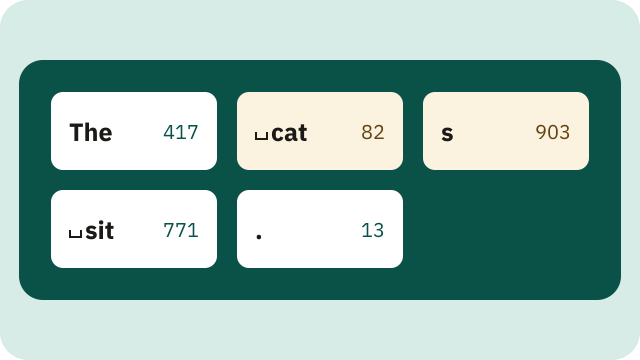
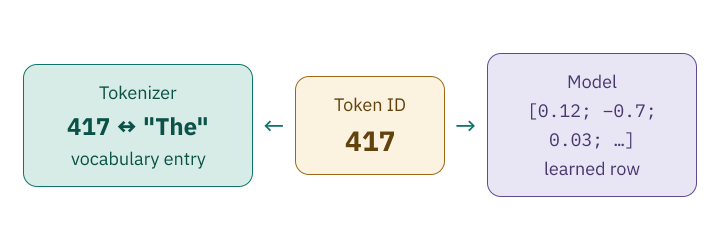
Each text piece in the vocabulary has a whole number, its token ID. Suppose “The” carries ID 417. This number is not the word translated into mathematics, and it measures neither meaning nor frequency nor importance. It is just the number on an index card. The 417 says nothing about what is written on the card; only looking it up in the card index makes the connection. So when a chatbot continues “The” sensibly, that is due to what its model learned, not to the 417.
That is why a token ID is ambiguous without its tokenizer. In another vocabulary, 417 can stand for “and,” part of a word, or a special character. Adding IDs would be pointless too: ID 417 plus ID 82 does not give the meaning of ID 499. In the model, the same number serves as an address for a list of learned numbers.
A complete toy example
Here is an invented mini vocabulary; a real tokenizer splits differently.
| Token ID | Text piece |
|---|---|
| 417 | “The” |
| 82 | “ cat” |
| 903 | “s” |
| 771 | “ sit” |
| 13 | “.” |
During encoding, the tokenizer receives the text “The cats sit.” With this mini vocabulary, there is exactly one split: “The” + “ cat” + “s” + “ sit” + “.”, because “ cats” is not in the list. Looking the pieces up in the vocabulary gives the sequence 417, 82, 903, 771, 13. These five numbers are the model’s input.
During decoding, the mapping runs backwards: the tokenizer looks up each ID and joins the five stored pieces in the same order. Because two tokens already carry their leading space, the result is “The cats sit.” again. An extra space would change it.
The example also shows why order matters. 417, 82, 903 is “The cats”; 82, 903, 417 gives “ catsThe”. The IDs form a sequence whose order is kept. From such sequences, a language model later learns which token is likely to come next.
Live demo · try it yourself
Your sentence, three tokenizers
Type a sentence. Three invented tokenizers split it at once and show every token with its ID. The word-piece tokenizer uses the mini vocabulary from the text.
Examples:
The way back: IDs become text again
Pick two IDs to swap them. The tokenizer looks up every ID and joins the pieces in this order.
All vocabularies and IDs are invented and tiny. Only the character IDs are real Unicode numbers. A real tokenizer knows tens of thousands of pieces and splits differently.
Spaces and punctuation are part of the input
People often treat spaces as empty gaps. For a tokenizer, they are characters like any other. Some vocabularies store frequent words with a leading space as separate entries. So “cat” with no space in front can be split differently from “ cat” in the middle of a sentence. Line breaks, tabs, quotation marks, and punctuation can likewise be tokens or part of larger units. Paste a table with lots of blank lines into a chatbot, and those characters become tokens, too.
Which numbers come out is set by the vocabulary of this one tokenizer alone. What happens if a model is fed with the wrong vocabulary?
Why the tokenizer and the model form a fixed pair
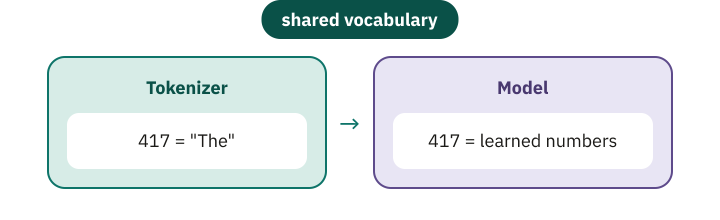
The model was trained with exactly one mapping. For input 417, its parameters draw on the list of learned numbers that was adjusted for entry 417 during training. Swap only the tokenizer, and the model receives valid numbers but the wrong symbols. It is as if someone had renumbered the index cards: 417 now says “and,” but the model expects what it learned for “The”.
The vocabulary size has to match as well, or the tokenizer produces IDs for which the model has no entry. So tokenizer files, vocabulary, rules, and special tokens are shipped and versioned together with a model. That is why a new chatbot model often comes with its own tokenizer, and the same sentence gives different IDs there.
One level deeper: why a vocabulary contains special tokens
Besides text pieces, a vocabulary often contains special tokens. They stand not for text but for structure. A real example is OpenAI’s early language model GPT-2. Its vocabulary has 50,257 entries with IDs 0 to 50256. The last entry, ID 50256, is called <|endoftext|>. In GPT-2, it serves as both the beginning and the end marker of a text sequence. When the model outputs this ID, the text is finished.
Chatbots need more such markers, because a conversation has roles. In the “harmony” chat format of OpenAI’s open gpt-oss models, every message begins with <|start|>. Then comes the role, such as user for you or assistant for the model. <|message|> introduces the actual content, and <|end|> closes the message. These markers are numbered entries too, with IDs around 200,000 for gpt-oss, in a much larger vocabulary than GPT-2’s. So one long token sequence shows the model who said what.
One detail protects this system. If you type the text <|endoftext|> yourself, it must not become special ID 50256, or anyone could slip fake markers to the model. Anyone building programs with OpenAI’s splitting tool tiktoken therefore has to decide: by default, tiktoken stops with an error at this text. On request, it splits it like ordinary text, into seven normal tokens instead of the one special token.
One level deeper: how BPE learns its vocabulary
Byte Pair Encoding, or BPE, began as a data compression method. For machine translation, it was adapted to represent rare and unknown words as sequences of smaller units instead of discarding them. Only a tokenizer that goes all the way down to bytes can do without a placeholder entirely. A byte is a small numeric unit in computer memory; every visible character is stored as one or more bytes, an accented letter or an emoji as several. Since there are only 256 different bytes, all of them fit into the vocabulary. Even a never-seen character can be assembled this way, and the letters of a new name are preserved.
BPE starts with small digital units. Depending on the variant, these are characters or bytes. It counts which neighboring pairs occur most often in the training material and merges the most frequent pair into a new unit; that is the “Pair Encoding.” This repeats until the desired vocabulary size or number of merges is reached.
If “l e a r n”, “l e a r n s”, and “l e a r n e d” are frequent in the material, letter pairs might become units first, and later larger sequences such as “learn”. Rare endings remain composable from smaller parts.
In use, the tokenizer replays the learned merges on new text in the same order, so the same text gives the same split. BPE is not the only subword method. SentencePiece learns subword models, including BPE, directly from unmodified sentences, without first cutting them at presumed word boundaries. This helps with languages that do not mark word boundaries with spaces the way English does. The shared idea: a limited set of learned units should represent any input as usefully as possible.
Why you notice tokens in everyday use
In a long chat with an AI assistant, the model eventually seems to forget the beginning. Or a service reports that your text is too long, although it is only a few pages. In both cases, the issue is not words but tokens.
Models process only a limited number of token positions at once, because memory and computation are limited. Depending on the system, this context window covers the input and the generated output. You know from the previous lesson why it forgets: in a chat, the whole conversation goes back into the model every round and grows with each answer. Once it no longer fits, the system must drop, shorten, or split part of it.
Some texts fall apart into especially many small tokens: an unusual product code, a long string of digits, or a language the vocabulary covers less compactly. They use more positions than familiar text of the same length, and many providers bill per token. Rules of thumb such as “one token is about four characters” only give you a rough idea. So for a concrete limit or cost estimate, count with the provider’s counting tool, not with a character formula.
What the tokenizer does not do
The tokenizer recognizes neither word meanings nor grammar nor intention. Sometimes its boundaries look linguistically sensible — such as “learn” and “ing.” That can be because these sequences were frequent in the training material; it is not a linguistic analysis. A token may cut right through a syllable, an ending, or a name.
Nor does the tokenizer decide which token comes next. It converts existing text into IDs and generated IDs back into text. Prediction happens in the model.
A common misconception: a model “understands” a word if it is a single token; if the word falls apart into many tokens, the model understands it less well or not at all. That sounds plausible, because one compact unit seems more complete than several fragments.
In fact, the model learned patterns across whole token sequences during training and can combine information from several positions. Whether a word is one token or several describes only its technical representation. So you cannot infer understanding from the token count. Still, the split has consequences: for some tasks, such as arithmetic with multi-digit numbers, performance measurably depends on how the digits are divided into tokens.
The numbers are only the beginning
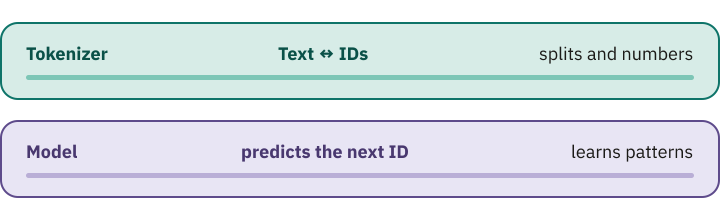
The complete path so far: visible text → tokenizer rules → token sequence → vocabulary lookup → sequence of token IDs. The text is numbered, but not yet in a form in which the model can calculate similarities and relationships.
In the next step, every ID serves as the address of a long list of learned numbers. What exactly is such a list, and how do you organize many of them, one per token? That is the topic of the next lesson: scalar, vector, matrix, and tensor.
If you remember only one sentence, make it this one: A token is a reusable text piece, its ID is only its number in the vocabulary, and only the model links that number to a list of learned numbers.
Explain it more simply
- Explain more simplyCore idea and an everyday comparison
- With an exampleOne concrete example, step by step
- In more detailEvery step on its own, in plain words
Recall moment
What stayed with you?
Answer without scrolling back. This is not a grade; the point is to retrieve what you learned from memory once. As soon as you pick an answer, you see whether it is right.
Preparing questions …
Questions from the community
Something still unclear? Ask your question about this lesson on the community board. Other learners and the project answer there, and you can see what others have already asked.